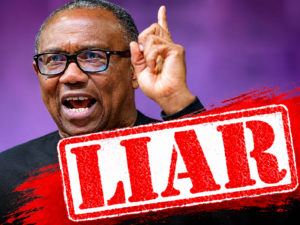
From Anambra to the Flamingos: Peter Obi’s Many Lies and the Rise of the King of Mendacity
How many times can a public figure make statements that are subsequently challenged by official records, independent fact-checkers and people directly involved in the events before Nigerians begin to question his credibility?
Peter Obi’s public statements have repeatedly attracted scrutiny over their accuracy. From economic statistics to claims about his administration in Anambra State and, most recently, an allegation involving Nigeria’s victorious Flamingos, there are several incidents that deserve closer examination.
The issue is not whether Peter Obi has the right to criticise the government. He does. The issue is whether the claims he presents to Nigerians are supported by facts.
A politician seeking the highest office in the country cannot continually make sweeping statements without being held accountable for their accuracy. Political narratives should not take precedence over verifiable information.
Here are some notable examples.
1. THE FLAMINGOS INCIDENT: ANOTHER CONTROVERSIAL ACCOUNT FROM PETER OBI
Following the historic victory of Nigeria’s U-17 women’s team, the Flamingos, at the 2026 FIFA U-17 Women’s World Cup, Peter Obi published a statement alleging that NFF officials prevented him from welcoming the victorious players at the Abuja airport.
Obi claimed that he arrived at approximately 7 a.m. while preparing to travel to Enugu. According to his account, he sighted the team and instructed his protocol officer to find out whether he could greet the players.
He alleged that he was subsequently informed that NFF officials had refused his request because they feared losing their jobs if they allowed him to approach the team.
He then presented the alleged incident as another example of what he described as toxic politics in Nigeria.
However, Bukola Olopade, Director-General of the National Sports Commission, strongly challenged Obi’s account.
Olopade explained that the aircraft carrying the Flamingos landed at approximately 5:30 a.m., when it was still dark. He further stated that the players exited through the international terminal’s underground exit, questioning how Obi could have sighted them from the domestic terminal as he claimed.
The NSC Director-General went further, describing Obi as a “pathological liar” and disputing the circumstances surrounding his account.
This raises serious questions about the credibility of the allegation. Obi attributed specific words and intentions to NFF officials, yet the circumstances he described were directly challenged by the head of the National Sports Commission.
Where is the independent evidence that officials threatened their jobs? Why should Nigerians accept such a serious allegation without verifiable supporting evidence?
Why the lies, Obi? The King of Mendacity!
2. THE ANAMBRA DEBT-FREE CLAIM: WHAT DO THE OFFICIAL RECORDS SAY?
Peter Obi has repeatedly maintained that he left Anambra State in 2014 without owing contractors, suppliers, pensioners or public servants.
During an interview on Arise Television in June 2025, he reiterated that he left office without outstanding obligations to those he had mentioned.
However, a fact-check published by The Guardian on June 11, 2025, examined this claim against official records from Nigeria’s Debt Management Office.
The records showed that, as of December 2013, Anambra State had domestic debt of approximately ₦3.03 billion and external debt of approximately $30.32 million.
The Guardian’s investigation concluded that Obi’s sweeping assertion that he left the state owing nobody was misleading.
The distinction between outstanding government debt and unpaid contractor invoices does not erase the existence of the debt recorded by the Debt Management Office.
When official records contradict an absolute public claim, Nigerians deserve an explanation.
How can a politician repeatedly make such sweeping assertions without adequately accounting for the official figures?
Why the lies, Obi? The King of Mendacity!
3. THE DEBT-TO-GDP FIGURES: WHEN THE NUMBERS DON’T ADD UP
During the Nigerian Economic Summit Group’s presidential economic dialogue in February 2023, Peter Obi made claims about the debt-to-GDP ratios of the United States, China, Japan and Singapore.
He cited approximately 90 per cent for the United States, over 60 per cent for China, 230 per cent for Japan and 130 per cent for Singapore.
TheCable subsequently investigated these figures and found them inaccurate. Its fact-check rated the claim FALSE, explaining that the figures presented for all four countries did not correspond with the data it examined.
This is particularly significant because Obi used these statistics as part of his argument about economic management and borrowing.
Economic statistics are not figures that should be casually presented to suit a political argument. They require accuracy, context and proper verification.
If a politician intends to use international economic comparisons to question the management of Nigeria’s economy, Nigerians should be able to trust that the figures being presented are correct.
TheCable’s fact-check provides a clear basis for questioning the accuracy of Obi’s presentation.
Why the lies, Obi? The King of Mendacity!
4. THE BIGGER QUESTION: HOW MANY MORE CLAIMS NEED FACT-CHECKING?
The examples examined above raise a broader question about the accuracy of Peter Obi’s public statements.
The Flamingos controversy, the Anambra debt-free assertion and the inaccurate debt-to-GDP statistics are three separate incidents, each involving claims that have attracted serious challenges from official records, public officials or independent fact-checkers.
They should not be dismissed simply because they are politically inconvenient.
Nigerians must be willing to examine the statements of every politician, including those who regularly present themselves as critics of the political establishment.
A public figure cannot demand accountability from others while treating scrutiny of his own statements as an attack.
The standard must be the same for everyone. If a statement is false, the evidence should expose it. If it is misleading, the facts should establish where the misleading impression comes from. And if an allegation cannot be substantiated, the public deserves to know.
Political popularity does not make inaccurate figures correct. Repetition does not turn an unsupported allegation into an established fact.
Ultimately, the question is not how convincingly a politician presents his arguments, but whether those arguments survive examination.
Why the lies, Obi? The King of Mendacity!
– Francis Okpara.