From the streets of Dakata in Kano to a press conference examining the Federal Government’s economic and development record, Mallam Alwan Hassan is taking his argument for President Bola Ahmed Tinubu’s reelection beyond political rallies. His message is that Northern Nigeria’s political future should be considered alongside the policies, investments and development opportunities that will shape the region for generations.
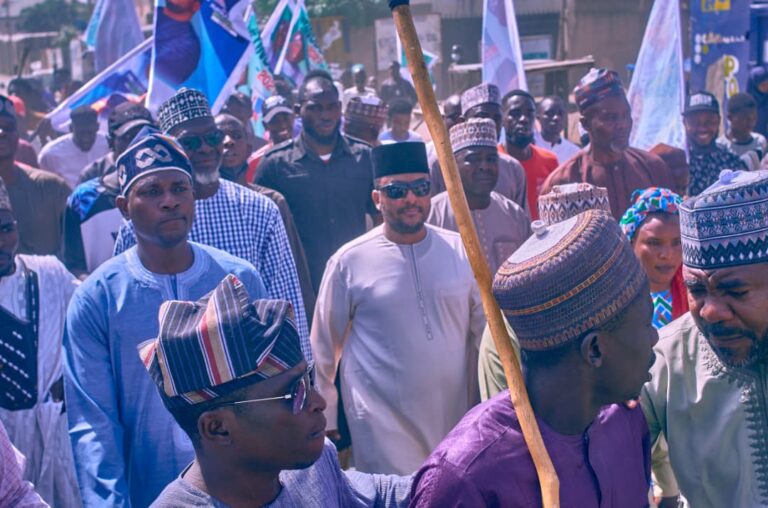
In Dakata, a densely populated community in Kano State, Mallam Alwan Hassan is a familiar face. Many know him simply as Chairman Dakata. His political activities have increasingly taken him from television studios and national political engagements to the streets of his community, where the everyday concerns of residents provide a different perspective on the country’s economic and political debates.
An All Progressives Congress (APC) chieftain and presidential campaign spokesman, Hassan has emerged as one of the prominent voices making the case for President Bola Ahmed Tinubu’s reelection in 2027. His approach combines national political advocacy with grassroots mobilisation. Last week, he led a door-to-door engagement in Dakata Ward, meeting residents, discussing government policies and listening to concerns about the economy and the challenges facing ordinary families.
He has also had conversations with community elders, religious leaders, young people and other stakeholders whose influence extends beyond formal party structures.
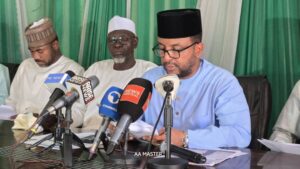
For Mal. Alwan Hassan, his argument is that government policies must be explained not merely in the language of economic indicators and official announcements, but in terms of their consequences for families, businesses, schools and communities. It was against this background that he addressed journalists in Kano on Thursday, October 29, 2026, presenting a detailed assessment of the Tinubu administration’s economic and development record.
His press conference followed a major APC campaign rally at the Ranchers Bees Stadium in Kaduna, which he described as an impressive demonstration of political organisation and enthusiasm.
But Hassan was careful to distinguish the excitement of political gatherings from the more demanding test of governance. “The real test of political leadership is what happens beyond the stadium: in our communities, in our schools, in our markets, on our farms and in the lives of ordinary Nigerians,” he told journalists.
That observation provides the central thread of his political argument. Northern Nigeria has long occupied a decisive place in the country’s electoral calculations. Its population, extensive geographical reach and political organisation make it indispensable to any serious presidential campaign. Yet the region also faces substantial development challenges. Educational exclusion, inadequate infrastructure, poverty, unemployment, agricultural underproductivity and insecurity have constrained economic opportunities across many northern communities.
These challenges are neither uniform nor peculiar to the North. Their intensity, however, makes questions of development especially consequential for the region.
Alwan Hassan’s argument is that the Tinubu administration’s record should be examined against this background. Rather than treating the administration’s reforms and programmes as isolated government announcements, he presents them as interconnected interventions addressing some of the structural conditions that have historically limited economic opportunities in Northern Nigeria.
Alwan Hassan began his assessment with the state of the Nigerian economy when President Tinubu assumed office in May 2023. At the time, Nigeria faced significant fiscal pressures, a fragmented foreign exchange market, rising inflation and severe constraints on public finances.
Drawing from the Federal Government’s State of the Economy presentation to the Federal Executive Council on October 28, 2026, Alwan Hassan highlighted several indicators.
Nigeria’s economy grew by 2.74 per cent in 2023. Net usable external reserves stood at approximately $859 million, despite gross reserves of about $35 billion. The foreign exchange market operated through multiple windows, with a spread exceeding 60 per cent. The country’s tax-to-GDP ratio was approximately 7 per cent, while debt servicing consumed about 97 per cent of government revenue.
These conditions placed considerable pressure on the government’s capacity to finance development.
The Tinubu administration responded with reforms that included the removal of petrol subsidy and the restructuring of the foreign exchange market. Alwan Hassan then argued that though these reforms have come with a cost, the longer-term economic indicators were beginning to demonstrate progress.
According to Alwan Hassan, Nigeria recorded real GDP growth of 4.43 per cent in the second quarter of 2026, compared with annual growth of 2.74 per cent in 2023. Headline inflation stood at 14.63 per cent in September 2026. Gross external reserves reached $55.1 billion on October 9, while net reserves were reported at approximately $46 billion. The foreign exchange market spread had narrowed to less than 5 per cent. The tax-to-GDP ratio had increased to 12.5 per cent, while the ratio of debt service to government revenue declined to approximately 65 per cent in the first half of 2026.
One of the most consequential issues Hassan raised was the increase in resources available to the three tiers of government. According to the figures he presented, net Federation Account Allocation Committee distributions increased from N15.2 trillion in 2024 to N21.9 trillion in 2025, representing growth of approximately 44 per cent. He also cited an increase in the share of state government expenditure devoted to capital projects, from 46 per cent in 2023 to 61 per cent in 2025.
These developments are significant because many of the public services that directly affect citizens fall within the responsibilities of state and local governments. Across Northern Nigeria, the need for better schools, healthcare facilities, rural roads, water infrastructure and other essential services remains considerable. Greater fiscal resources is providing state governments with additional capacity to address these needs.
For example, a state with improved revenue can rehabilitate more classrooms, equip primary healthcare centres, improve rural transportation networks or expand access to clean water.
Of all the programmes discussed at the press conference, the Nigerian Education Loan Fund appeared to command Hassan’s strongest personal enthusiasm.
“I will never get tired of speaking about NELFUND,” Alwan declared. He described it as one of the most impactful programmes of the Tinubu administration.
His emphasis reflects a challenge familiar to families across Northern Nigeria: the difficulty of financing higher education. For many households, the cost of tertiary education extends beyond tuition and institutional charges. Accommodation, transportation, feeding, books and other expenses can place considerable pressure on family finances. Where household incomes are limited, these costs can determine whether a young person continues their education or abandons it.
Hassan recalled the experiences of parents who have borrowed money, sold possessions or made difficult sacrifices to keep their children in school. Others, he observed, have watched their children discontinue their education because the family could no longer afford it.
According to him, NELFUND had disbursed N372.6 billion in student loans as of September 2026, with 1.66 million applications processed. The programme is intended to reduce financial barriers to tertiary education by providing eligible students with access to loans.
For Northern Nigeria, where educational disadvantage remains a significant development concern in many communities, the potential implications are considerable.
Expanding access to higher education is helping produce the teachers, doctors, engineers, scientists, administrators and entrepreneurs required to support the region’s development. It is also creating opportunities for young people whose educational ambitions might otherwise have been constrained by their families’ financial circumstances.
Alwan Hassan’s assessment of the administration’s educational record extended beyond student financing. He argued that meaningful investment in education must address three interconnected priorities: access for students, welfare for academic staff and infrastructure for educational institutions.
On academic staff welfare, he highlighted the administration’s settlement of outstanding Consolidated Academic Tools Allowance arrears. Hassan placed particular emphasis on the scope of the intervention, declaring that President Tinubu had cleared all outstanding CATA arrears for academic staff across the country. He presented this as an important development in addressing longstanding welfare concerns within the tertiary education system.
The relationship between academic staff welfare and educational quality is difficult to ignore. Universities and other tertiary institutions depend on qualified lecturers, researchers and administrators to train students and advance knowledge. Where remuneration and working conditions remain inadequate, institutions can struggle to retain experienced personnel, sustain research activities and maintain teaching standards.
These challenges affect institutions across the country, including universities and colleges serving Northern Nigeria. Alwan Hassan also cited the disbursement of N38.93 billion to 166 public tertiary institutions through the Needs Assessment Revitalisation Funds. The intervention is intended to improve teaching and learning facilities and address infrastructure deficiencies. The significance of such investment lies in the relationship between educational facilities and the quality of training. Students studying engineering require functional laboratories and equipment. Medical students need appropriate teaching facilities. Researchers require infrastructure that supports experimentation and innovation.
Beyond education, Alwan Hassan also addressed the administration’s social protection programmes. He stated that more than 10 million households had been reached through the Federal Government’s cash transfer programme, with over N600 billion disbursed. The programme provides N75,000 per beneficiary household in three instalments.
One of the most forward-looking aspects of Alwan Hassan’s press conference concerned the National Agency for Science and Engineering Infrastructure (NASENI).
The agency’s activities received considerable attention in his remarks, particularly its efforts to strengthen domestic manufacturing, technological innovation and technical skills. Alwan Hassan noted that NASENI’s Board is chaired by President Tinubu and that the agency is led by Khalil Halilu, a native of Kano State.
He highlighted the partnership involving the Massachusetts Institute of Technology, NASENI and the Presidential Implementation Committee on Technology Transfer to establish regional acceleration programmes for innovation and entrepreneurship. Among the initiatives he discussed was an agricultural hub in Adamawa State, covering approximately 40,000 hectares. The hub is designed to bring together agricultural production, processing and commercialisation within an integrated ecosystem. Its proposed model addresses a longstanding challenge in Northern Nigeria: the gap between agricultural potential and agricultural productivity.
The North possesses extensive agricultural resources, with millions of people engaged in farming, livestock production, trading and related activities. Yet agricultural output is often constrained by inadequate mechanisation, limited processing capacity, insufficient storage infrastructure, transportation difficulties and restricted access to modern technologies. These constraints affect both productivity and the incomes of farmers. An integrated agricultural ecosystem that connects production to processing and commercial markets could help address several of these challenges.
Mal Alwan Hassan also drew attention to NASENI’s engineering and industrial programmes. He cited the agency’s training of thousands of engineers, its assembly of Made-in-Nigeria vehicles, its work in drone development and its efforts to train Nigerians in drone operations. These activities point towards a broader industrial ambition of the President Tinubu administration. For decades, Nigeria has depended heavily on imported machinery, equipment and manufactured products. Developing domestic technical capacity can help reduce some of that dependence while creating opportunities for skilled employment and local enterprise.
Infrastructure occupied a substantial part of Mallam Alwan Hassan’s presentation. He argued that the administration’s road investments are especially important to Northern Nigeria because of the region’s dependence on agriculture, commerce and the movement of goods over considerable distances.
So far, he stated, more than 6,000 road projects were either ongoing or had been completed across Northern Nigeria under the Tinubu administration. He also stated that 348 kilometres of roads had been completed in the North-West, out of 1,016 kilometres completed nationwide.
The economic significance of road infrastructure is considerable. A farmer’s ability to sell produce profitably can depend on the condition of the road connecting a village to the nearest market. A trader’s transportation costs influence the final prices paid by consumers. Manufacturers require reliable routes to receive raw materials and distribute finished products. Poor road conditions increase transportation costs, delay deliveries and can contribute to losses, particularly for perishable agricultural products. Improved roads can therefore affect the profitability of agriculture, the competitiveness of businesses and the accessibility of essential services.
Among the projects Alwan Hassan identified was the Akwanga–Jos–Bauchi–Gombe–Biu–Maiduguri Superhighway. The approximately 700-kilometre corridor is designed to connect communities across the North-Central and North-East geopolitical zones. In July 2026, the Federal Government flagged off construction of its first section, covering approximately 125 kilometres from Akwanga in Nasarawa State to Jos in Plateau State. When completed, the corridor is expected to improve regional connectivity and facilitate the movement of agricultural produce and other goods.
Its potential economic importance extends to the integration of markets across several states. A more efficient transportation network can help connect agricultural production centres with processing facilities, urban markets and commercial distribution routes.
Hassan also highlighted progress on the Abuja–Kaduna–Zaria corridor. According to him, the first 118-kilometre section had been completed, including 81 kilometres constructed with reinforced concrete pavement. Work continues on other sections, while the President has directed the installation of solar-powered streetlights along the entire 375-kilometre corridor.
The importance of this route is evident in the economic relationship between Abuja, Kaduna and Kano. It serves passenger transportation, trade, manufacturing and the movement of agricultural and industrial goods. Improving the corridor would reduce transportation difficulties and support commercial activity between these major economic centres.
Other projects identified by Alwan Hassan included the Sokoto–Badagry Superhighway, Kano Northern Bypass, Kano–Katsina Road, Zaria–Funtua–Gusau–Sokoto Road and sections of the Kano–Maiduguri Road.
As a Kano indigene, Alwan Hassan also took time to highlight interventions by the Universal Basic Education Commission in Kano State. According to him, these interventions included the renovation of more than 50 primary schools across 15 local government areas, the rehabilitation of classroom blocks and the provision of over 16,000 furniture items.
He also cited the Executive Secretary of UBEC, Dr Aisha Garba, where she stated that nearly 4,000 classrooms had been delivered across Kano State. These interventions address a critical dimension of Northern Nigeria’s development challenge. Basic education provides the foundation upon which subsequent learning, technical training and professional development depend.
Where children lack access to suitable classrooms, furniture and appropriate learning facilities, their educational experience can be compromised. Improving school facilities is therefore an important part of expanding access to quality education.
For Kano, a state with a substantial school-age population, investments in classrooms and educational infrastructure is strengthening the foundations of human capital development.
As Nigeria approaches the 2027 presidential election, Northern Nigeria will remain central to the country’s political calculations. Its electoral importance is well established. But the political choices of its citizens are shaped by more than geography or party organisation.
For Alwan Hassan, the Tinubu administration’s policies are addressing the everyday concerns of the people of Northern Nigeria. Mallam Alwan Hassan has presented the Tinubu administration’s record as evidence of progress in education, infrastructure, agriculture and other structural areas as the foundation of his argument for a President Tinubu’s second term.
— Bello Baba Kawu is a journalist and writes from Kano State